Wednesday, October 29, 2008

Isaac Newton


Isaac Newton
1643-1727
*He suggested that a particle, if released, would spiral in to the center of the Earth. Hooke wrote back, claiming that the path would not be a spiral, but an ellipse.
http://scienceworld.wolfram.com/biography/Newton.html

Galileo Galilei


Galileo Galilei
1564-1642
*pioneered "experimental scientific method" and was the first to use a refracting telescope to make important astronomical discoveries
*discoveries using his new telescope, including the moons of the planet Jupiter and the phases of the planet Venus (similar to those of Earth's moon).
*Galileo's observations with his new telescope convinced him of the truth of Copernicus's sun-centered heliocentric theory.
* Galileo's support for the heliocentric theory got him into trouble with the Roman Catholic. Sentenced to life imprisonment.
*
http://www.lucidcafe.com/library/96feb/galileo.html

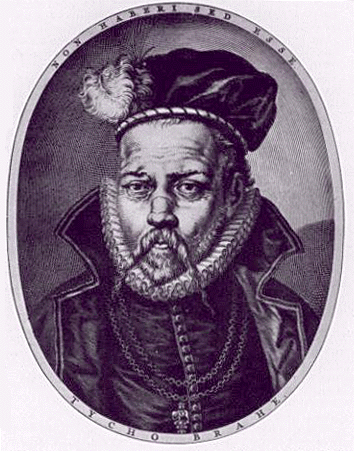
Tycho Brahe


Tycho Brahe
1546-1601
* made a remarkable star catalogue of over 1000 stars
*He proved that comets are not objects in the atmosphere.
http://www.nada.kth.se/~fred/tycho/index.html

Tuesday, October 28, 2008

Copernicus


Copernicus
1473-1543
*Proposed that the Sun, not the Earth, was the center of the Solar System. Such a model is called a heliocentric system in the 16th century.
http://csep10.phys.utk.edu/astr161/lect/retrograde/copernican.html


Henrietta Leavitt


Henrietta Leavitt
1868-1921
*determine a star’s photographic brightness. Leavitt determined the absolute magnitude of about 47 stars near the North Pole. These stars were used as a standard to determine others stars’ brightness
http://pvastro0714.blogspot.com/2008/03/henrietta-swan-leavitt.html

James Van Allen


James Van Allen
1914-2006
* best known for discovering radiation belts encircling Earth
http://www.astronomy.com/asy/default.aspx?c=a&id=4452

Albert Michelson (Michelson-Morley experiment)


Albert Michelson (Michelson-Morley experiment)
1852-1931
* In 1878, began to work on confirming the existence of the mysterious "aether."
http://www.usd.edu/phys/courses/phys300/gallery/clark/mich.html